
STAY UP TO DATE

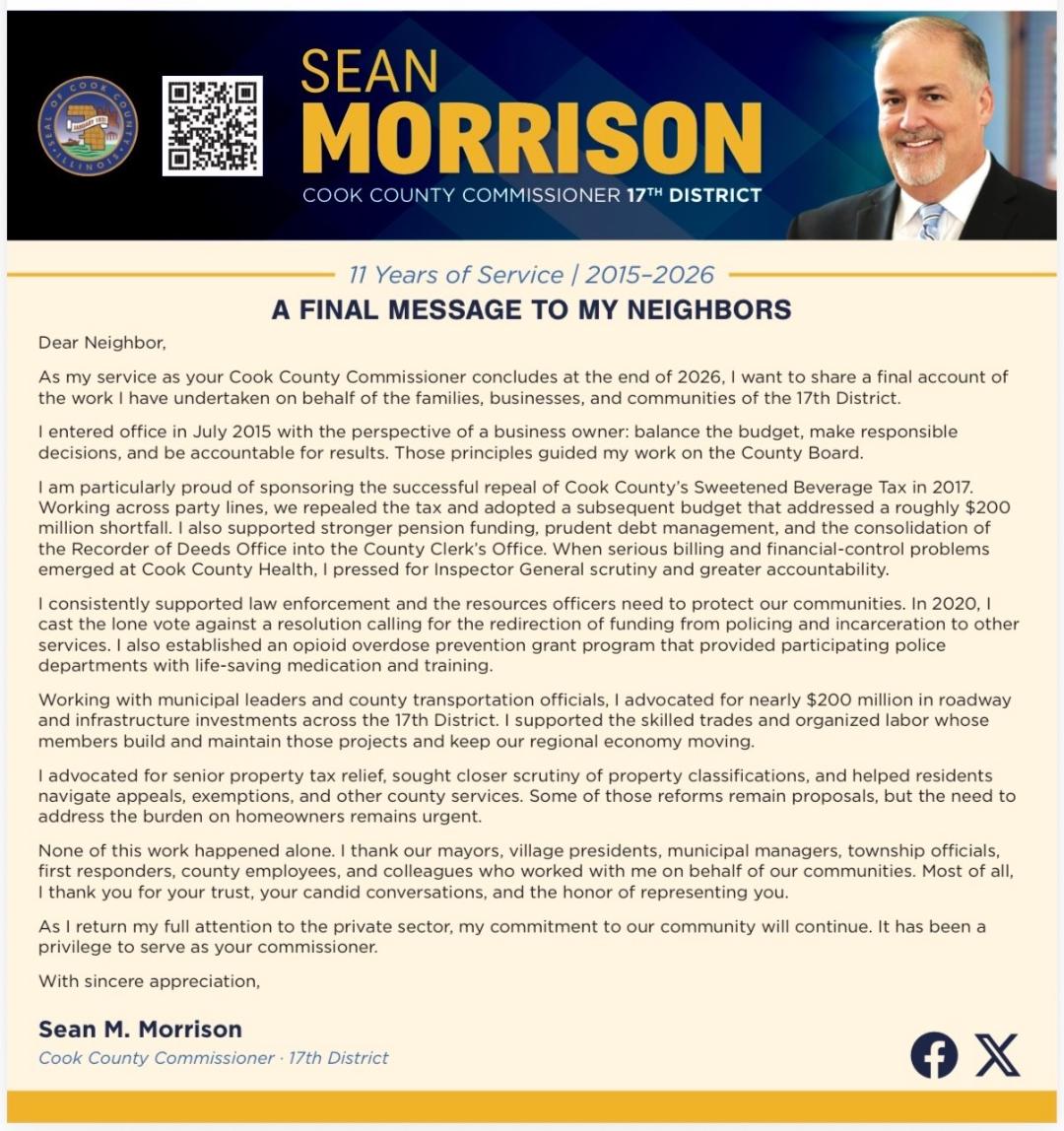
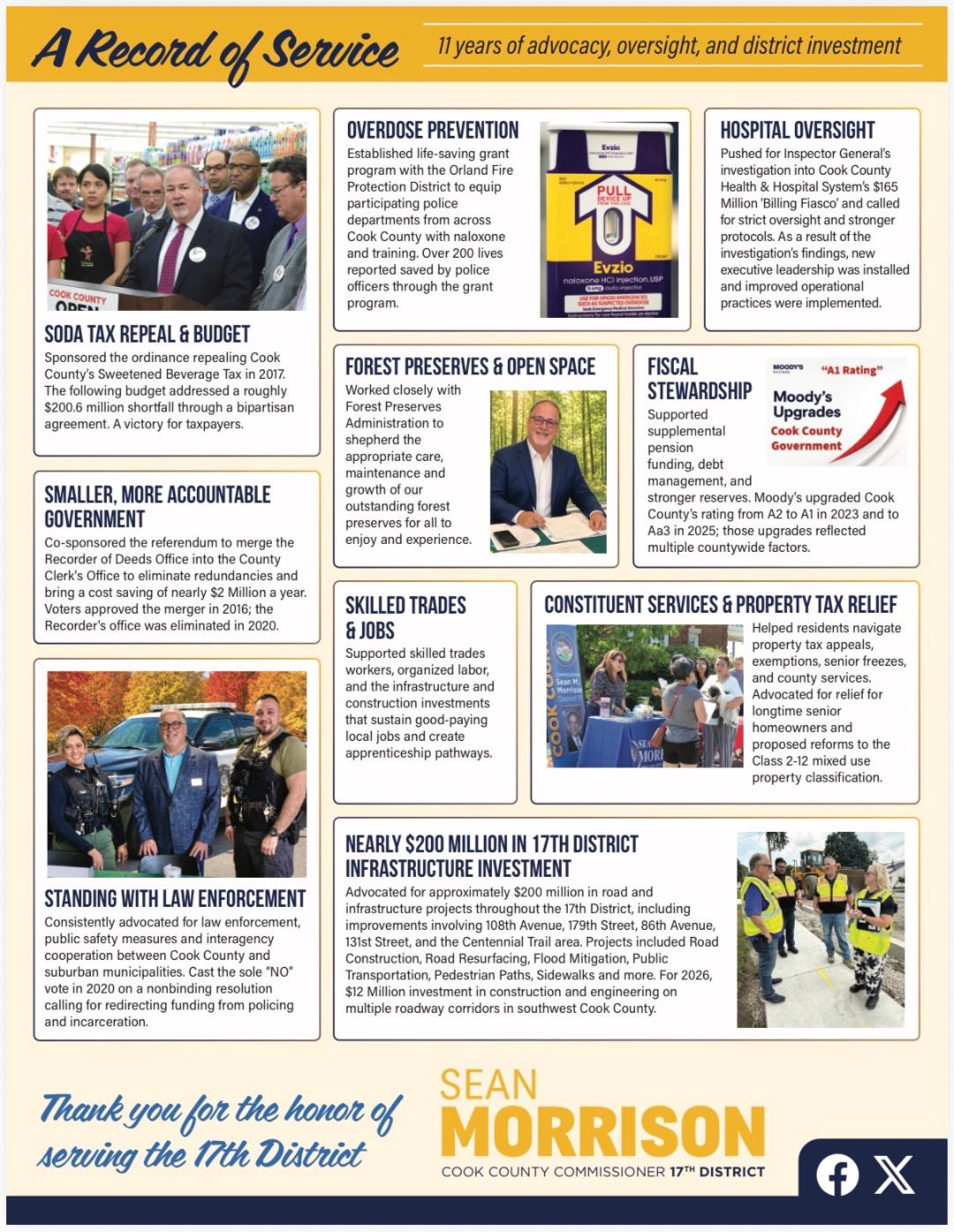
17th District Newsletter - A Final Message from Commissioner Sean Morrison October 5, 2026
CLICK ON THE YOUTUBE VIDEO TO WATCH COMMISSIONER SEAN MORRISON'S INTERVIEW WITH FOX 32 NEWS ON THE BREAKDOWN OF LAW ENFORCEMENT COOPERATION AND THE FAILURE OF SANCTUARY POLICIES


Cook County Commissioner Sean Morrison Sponsors Resolution Urging the State of Illinois to Opt-in to the Federal Scholarship Tax Credit Program


On April 29, Commissioner Sean Morrison joined nationally syndicated Talk Show Host Vince Coglianese on his podcast to discuss Governor JB Pritzker's inflammatory political remarks from the previous weekend. Click on the video image below and go to the 22 minute mark to watch Vince's interview with Sean.


Unsustainable Migrant Crisis Wreaking Havoc on Illinois and Local Communities - Time for Border Closure

Headlines
Tomorrow, the Cook County Board of Commissioners will vote on Item No. 17-1636. It is a resolution formally requesting President Donald Trump send additional federal resources to Chicago.
The resolution calls for additional resources for law enforcement, additional federal law enforcement agents and economic investment in communities across the county.
We are distressed because it appears that a substitute that has been proposed places politics over the lives of Cook County citizens. The original item is bi-partisan and specifically spells out the resources the federal government can offer to help quell the violence in Cook County. The substitute does not.
“This is not a political issue,” said Commissioner Boykin. “This is a human issue. It would be a travesty to not work with the administration to ensure the right kinds of resources are coming to Chicago simple because we may have political disagreements.”
The resolution also makes clear that the National Guard is in no way an appropriate response. That is why it is important for local leaders to begin having a conversation with President Trump and Washington.
“With the rising death toll, not accepting an offer of federal help at this juncture would be an inexcusable dereliction of duty by our elected leaders,” said Commissioner Morrison. “We cannot continue to repeat the same conversations and apply the same stagnant strategies and methods to no avail. We have an obligation to put all people’s lives before partisan politics.”
Commissioners Boykin and Morrison urge their colleagues to support the original item. It is imperative that the violence Chicago saw in 2016 is not repeated in 2017. The status quo is beyond acceptable.
By Kristen McQueary
June 30, 2017
Property taxes on the climb.
An income tax hike debated in Springfield.
An unpopular soda tax in Cook County.
Residents with their pockets inside-out in Chicago.
It appears there’s an awakening among Illinois voters. And it’s about time, after decades of risky borrowing, faulty promises, weak-kneed politicians.
Springfield officials predict they’ll need nearly $8 billion for the upcoming fiscal year to make a pension payment to the funds that support retired teachers, university workers, judges, politicians and state workers.
It won’t be enough.
Chicago Public Schools needs hundreds of millions of dollars to slow the school district’s slide toward financial collapse.
It won’t be enough.
The city of Chicago’s pension funds, while Mayor Rahm Emanuel has tried to prop them up, are draining toward empty.
There simply isn’t enough taxpayer tolerance, or union cooperation, to bridge these systems to recovery. It’s too late.
You know the scene in the movie “Goodfellas” when Henry, actor Ray Liotta’s character, is worried about the pasta sauce, but drug enforcement helicopters are circling his house? That’s Illinois. The Too Late State.
Elected officials knew this was coming. They watched as liabilities in their own employee pension funds rose, even as the statutorily required payments were made. That rising liability was a neon sign that the pension systems eventually would topple, but it sure is hard to spot clues when you’re spinning like the Tasmanian devil from one carefully messaged election to the next.
Years ago, when former Gov. Rod Blagojevich created a pension task force to study the state’s five funds, the report that emerged illuminated the insurmountable strain of pension costs on the state budget.
I remember approaching former state Rep. Robert Molaro, D-Chicago, who served on the task force, about the findings. I was alarmed. He was not. In fact, he sponsored several bills that sweetened the pensions of city and state workers, and teachers. This was in the early 2000s.
What a dope I must have seemed, earnestly questioning him about why he would sponsor legislation he knew would cause more damage to the pension systems.
This was around the time Senate President John Cullerton sponsored a bill to give local governments more tools to borrow money. He joked, as he introduced it, not to ask him any hard questions. The bill had been written by bond interests. The Tribune’s 2013 “Broken Bonds” investigative series revealed that Chicago Public Schools by 2007 had issued around $1 billion in risky bonds made possible under that bill.
Mayor Emanuel’s City Hall has continued to use high-cost borrowing methods to “balance” Chicago’s books. Emanuel and the City Council routinely rely on borrowing to pay off debt. Emanuel has promised that those habits will phase out. But the damage is done.
And yet there they all are, each an Eddie Haskell impostor: “Who me? I am only trying to be reasonable and cooperate, Mrs. Cleaver.” Emanuel blames Gov. Bruce Rauner. Rauner blames House Speaker Michael Madigan. Madigan blames Rauner. Cook County President Toni Preckwinkle blames Republicans.
I blame us.
It’s true, the cliche that this debt did not pile up overnight. It might be the most painful indictment of voters who weren’t paying close enough attention, or didn’t want to, for so long.
But we are paying attention now.
Why do you think even the most tax-happy lawmakers in Springfield are glancing toward the exits as an income tax vote creeps closer? They have finally figured out what’s on the other side.
Kristen McQueary is a member of the Tribune Editorial Board.
Editor, Journal: Cook County Board President Toni Preckwinkle made a comment this past week about suburban communities that have opted out of Cook County’s minimum wage hike and paid sick leave ordinances by calling them, “shortsighted and self-centered.” When I heard this comment I could not help but think that it is one that drips with irony.
Diligent and prudent is the approach suburban communities took to assess the impact these two ordinances will have on their towns. That is in stark contrast to the autocratic approach taken by the Cook County administration when it rushed to pass these two ordinances within 30 days of each other while accepting little or no input from suburban communities. Moreover, legal opinions rendered on both ordinances deemed them to go beyond Cook County government’s scope of authority under the state constitution. Therein lies the epitome of shortsightedness and a self-centered attitude.
More than 60 suburban communities have opted out from these ordinances. Suburban elected officials have a fiduciary duty to protect the best interests of their towns, and in my opinion, they have made the correct decision to avoid the negative economic impact these two ordinances will have on their towns’ local economies.
I agree with suburban leaders who foresee these ordinances creating a costly economic disadvantage for their towns that compete with the collar counties and neighboring Indiana. I also agree that these ordinances have the ability to stifle economic development for suburban communities as well as constrain existing businesses from growing and creating more jobs.
That is why it should be state government, not local units of government like Cook County, that create economic policies that are fair and balanced for all communities across our entire state.
Sean M. Morrison, Cook County Commissioner, 17th District
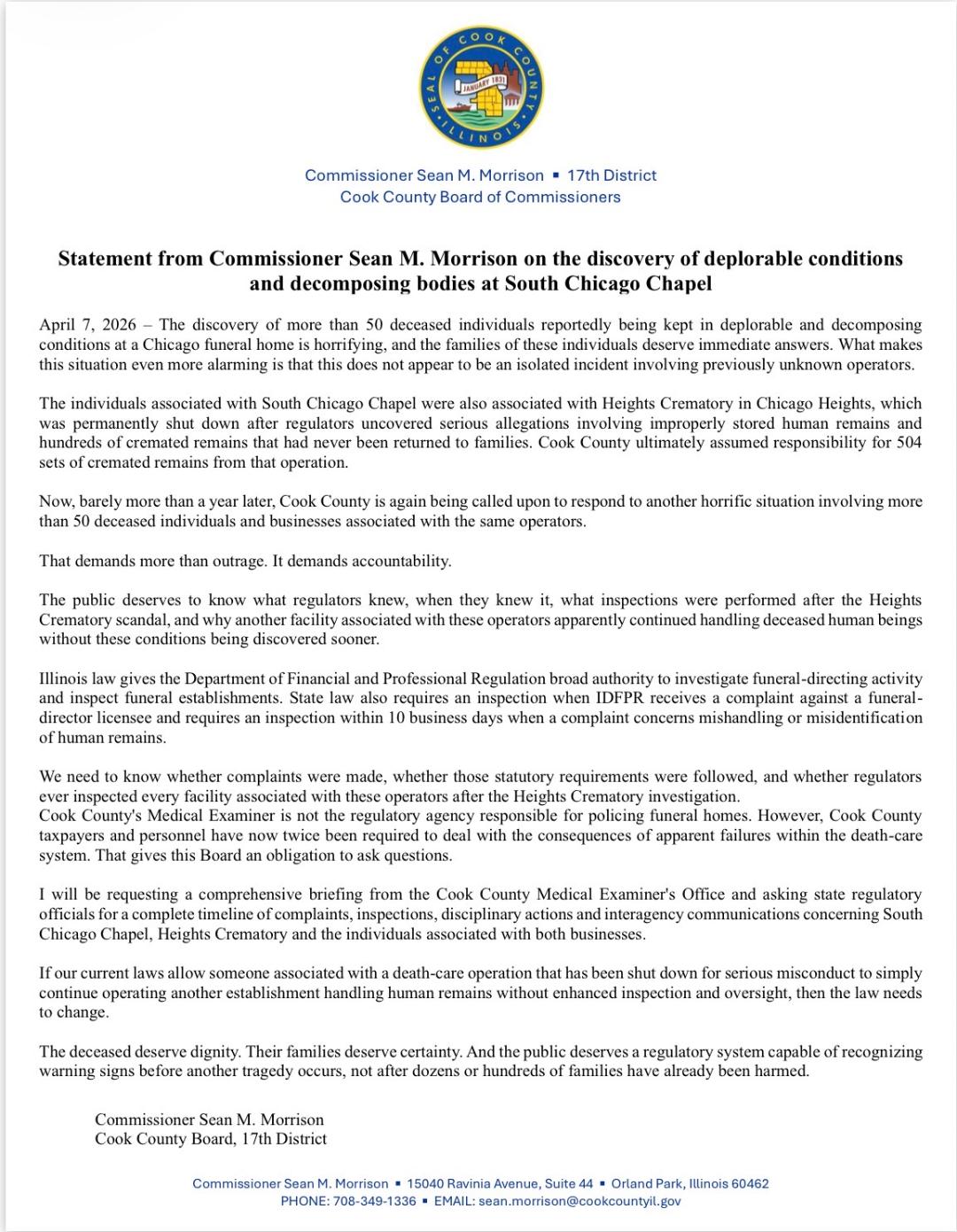
Chicago, IL – After numerous negotiations over the last 48 hours, an agreement has been reached with 11 of my fellow commissioners to sign onto the Sweetened Beverage Tax Repeal Ordinance which will be called for a vote in the Finance Committee on Tuesday, October 10.
This morning, I submitted a substitute amendment to my original repeal ordinance that calls for the elimination of the Cook County Sweetened Beverage Tax effective December 1, 2017 which is the beginning of Cook County’s fiscal year. Joining onto my substitute amendment as co-sponsors are Commissioners Richard Boykin, John A. Fritchey, Timothy O. Schneider, Jeffrey R. Tobolski, Peter N. Silvestri, Bridget Gainer, Gregg Goslin, John P. Daley, Jesus G. Garcia, Stanley Moore and Dennis Deer.
“I would like to thank my colleagues for working together so diligently to come to an agreement on such an important issue to our constituents and to Cook County. It has not been easy task but in the end, we have reached an agreement that will address the concerns of our residents and businesses and set forth a goal to chart a new fiscal course for Cook County,” said Commissioner Morrison.
The agreement reached on the substitute amendment will allow for Cook County government to close out the final seven weeks of its fiscal year with the tax in place. This will then provide a clean slate for the Cook County Board to begin its 2018 Cook County Budget Process in the coming weeks.
“I’m committed to working in a bipartisan and constructive manner with all of my board colleagues, President Preckwinkle and her administration to take the needed steps to find the fiscal solutions to create a balanced and responsible 2018 Budget for Cook County,” stated Commissioner Morrison.
Please find Commissioner Morrison’s Press Release and full Substitute Amendment below:
Below you can find the Illinois Department of Transportation’s (“IDOT”) update regarding the construction on 159th Street in Orland Park.In summary, IDOT projects the new eastbound lanes will be opened by December 2017, allowing construction to begin on the new westbound lanes, which they anticipate will be complete and open by December 2018.
You can read and download the full timeline below.
If you have any questions or concerns, please do not hesitate to contact my District Office at (708) 349-1336.
Contact Us
Chicago Office
118 N. Clark Street, Suite 567
Chicago, Illinois 60602
Phone : 312-603-4215
Fax: 312-603-2014
District Office
15040 Ravinia Ave, Suite 44
Orland Park, Illinois 60462
Phone: 708-349-1336
Fax: 708-349-1627